The Chapelle de la Miséricorde was blessed in 1639 under Prince Honoré II, prior of the Black Penitents; in 1813 they merged with the White Penitents into the Confraternity of Mercy. Built at the height of the Baroque, it is rich in sculpture, painting, gilding and marble: a recumbent Christ carved by the Monégasque François-Joseph Bosio, Napoleon's official sculptor, a façade ceramic of 1909 by Ernesto Sprega, frescoes of the Assumption of 1953, and a relic of Saint Dévote. On the eve of Good Friday a torchlit procession leaves from here.
The building
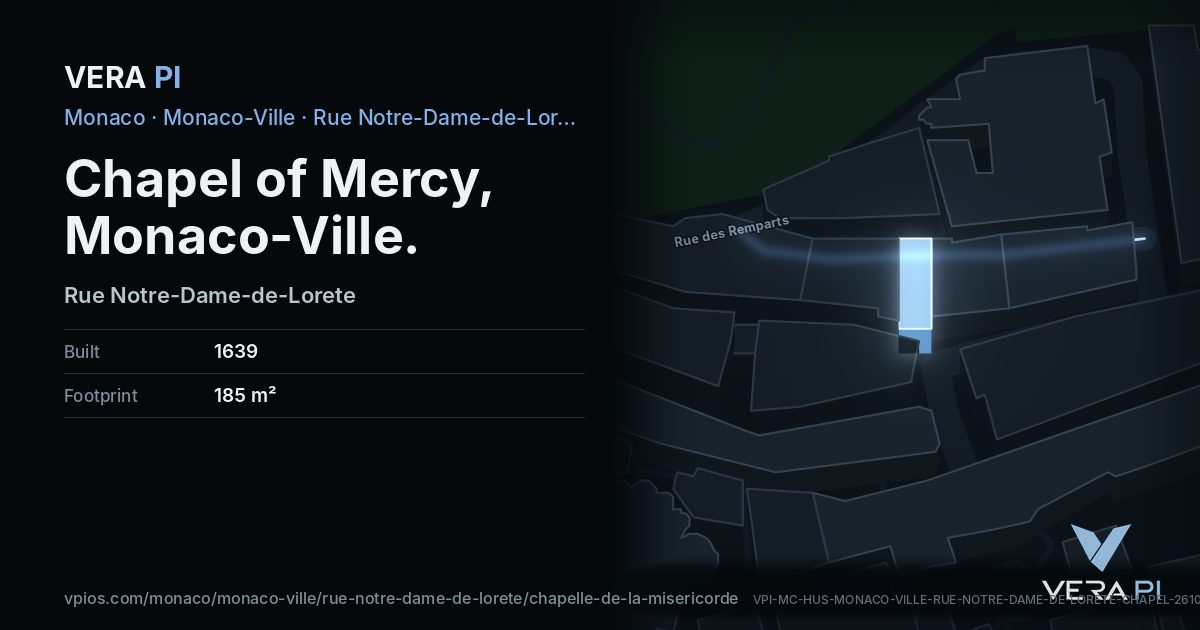
Rue Notre-Dame-de-Lorete, Monaco-Ville, Monaco – facts from the open sources, each with its source.
Facts
- Address
- Rue Notre-Dame-de-Lorete
- Use
- Place of worshipOpenStreetMap
- Built
- 1639Metro Mode
- Footprint
- 185 m²OpenStreetMap
- Style
- BaroqueMetro Mode
- Built as
- Confraternity chapelMetro Mode
- Commissioned by
- Prince Honoré II, prior of the Black PenitentsMetro Mode
- Quartier
- Monaco-Ville
Getting there
- Nearest bus stop
- Princesse Stephanieline 3, line 4, line 6, line N1 · 2 min on foot
- Beach
- Plage du Solarium8 min on foot
- Port
- port de Fontvieille5 min on foot
- From the Casino
- 17 min on footestimate, with the stairs and lifts
- From the Palais
- 5 min on footestimate, with the stairs and lifts
Nearby
Eat & drink
See
Share
Its own link and its own card – for a message, a story or a plan for the evening.
Sources
Building outline, height, floors, use and address: © OpenStreetMap contributors, ODbL 1.0.
Wikidata (CC0) and Wikipedia (CC BY-SA 4.0); the photograph from Wikimedia Commons under its own licence.
Buses: Compagnie des Autobus de Monaco GTFS (Licence Ouverte 2.0).
Wikipédia (fr) : Chapelle de la Miséricorde de Monaco
Wikipedia (en): Monaco-Ville